

Access keys | Skip to primary navigation | Skip to secondary navigation | Skip to content | Skip to footer |
Problems viewing this site
     Chapter Headings
previous   PAGE   next  
Governance

Internal auditing

The Department’s Internal Audit Unit operates under an approved charter, consistent with provisions of the Financial Administration and Audit Act 1977 and the Financial Management Standard 1997, which establishes its role, scope and operating parameters.

The unit reports directly to the Director-General and has reporting relationships with a range of stakeholders including the Department’s Audit and Risk Management Committee and the Queensland Audit Office.

The unit carried out the following work during 2003-04:
  • identified key risk areas within the scope of departmental activities, which were incorporated into the unit’s 2004-05 Operational Plan.
  • provided secretariat and consultancy support to the Workplace Safety Review Executive Management Group Sub-Committee and the Audit and Risk Management Committee.
  • commenced an initiative to bring operationally experienced staff into the unit on three-month secondments.
  • issued 18 reports related to governance including audits of financial controls, information systems, human resource management and delegations. Recommendations focused on improvements required to systems of control and process.
  • issued four reports relating to the evaluation of offender management processes that occurred in a range of area offices located throughout the State.
  • issued two reports relating to community projects, special conditions and fine option orders.
  • issued five reports on activities concerning the integrated and effective management and supervision of offenders in accordance with assessed risks and needs. These reviews ranged from support services to operational reviews of activities and functions undertaken within correctional centres. Recommendations were made to management about enhancements to offender management practices and operational requirements.
During the year, the Audit and Risk Management Committee endorsed changes to the Internal Audit Charter which included:
  • the purpose of having a Charter.
  • the independent status of internal audit.
  • competence and standards of internal audit including compliance with the Standards, Codes of Conduct and Ethics recommended or promulgated by the relevant professional bodies (e.g. Institute of Internal Auditors and CPA Australia).


GAP project

The Department has continued to strengthen its risk management program over the past year through the further integration of risk management processes into departmental management practices.

The development and implementation of a risk management framework now forms an integral part of strategic, operational, contingency, business continuity and project-based management and planning practices.

Through this risk management framework the Department has gained:
  • a comprehensive business continuity model
  • a better understanding of its business and operating environments
  • identified areas of critical risk and opportunity for improvement, and
  • continued to refine the assessment and review of prisoner risks and needs for targeted intervention strategies to assist in reducing recidivism.
Additionally, the implementation of the Counter-Terrorism Risk Management Framework - Government Agency Preparedness (GAP) project - has ensured that appropriate counter-terrorism risk treatments are in place.

These treatments are designed to reinforce security controls around correctional facilities, information management, on-site emergency response, disaster recovery and business continuity to ensure the uninterrupted supply of the Department’s services in protecting the community.

A testament to the Department’s success in this area has been the establishment of a multi-agency agreement with the Department of Emergency Services and Queensland Police Service to facilitate an integrated response to an emergency or disaster event in a correctional facility.

The Department’s risk management focus for 2004-05 will be continual improvement through ongoing review, monitoring, communication, training and testing of risk treatment plans for enhanced organisational performance.

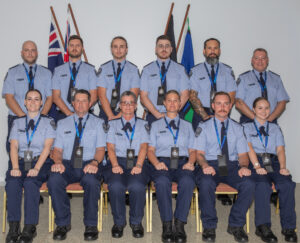
GAP project members Members of the DCS Business Continuity Committee include, back from left, John Forster, David Sutch, Steve Simmons, Donna Hamer, and front, Vikki Moodie, Jenny Briant and Anita Haber

Department of Corrective Services
Annual Report 2003-04
previous   PAGE   next